
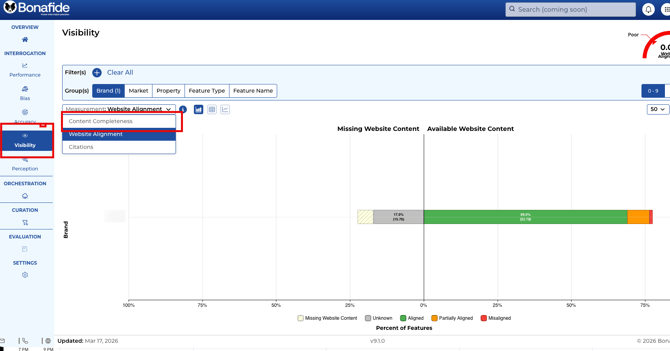
Where can I find Website Alignment?
What is Website Alignment?
Website Alignment measures how well your website content is reflected in what large language models (LLMs) are telling users.
Think of it as a real-time health check: if your website were the only source of truth for AI, how accurately is that information being communicated?
Every prompt in your question set is evaluated against what your website actually says, then compared to how LLMs respond. Both sides of the comparison are dynamic — as your website content changes and as LLMs update their knowledge, your alignment scores will shift accordingly.
How does Bonafide determine "What LLMs are saying"?
Bonafide uses a methodology called LLM Consensus to establish a reliable, stable answer for each prompt. Here's how it works: Bonafide interrogates 5 leading large language models with the same question. If at least 3 out of those 5 LLMs return the same answer, that shared response is designated the consensus answer — and that is what Bonafide uses as the LLM side of the comparison when calculating your alignment score.
This approach ensures that your alignment results aren't skewed by the quirks or outlier behavior of any single model. It reflects the answer a traveler is most likely to encounter, regardless of which AI assistant they happen to use.
Aligned
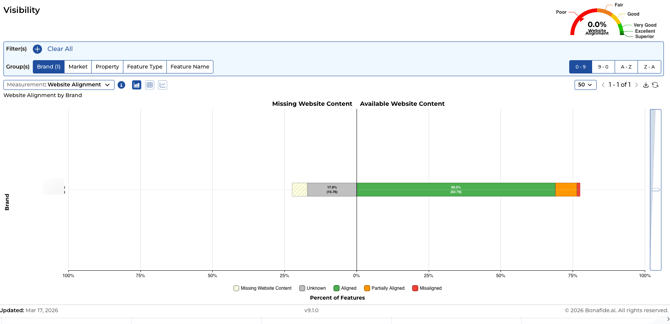
A prompt is marked Aligned when your website has a clear answer to the question being asked, and the large language models are saying essentially the same thing. This is the healthy state — it means the information on your website is making its way into AI responses accurately. When travelers ask an LLM a question that falls into this category, they're getting an answer that matches what's on your site.
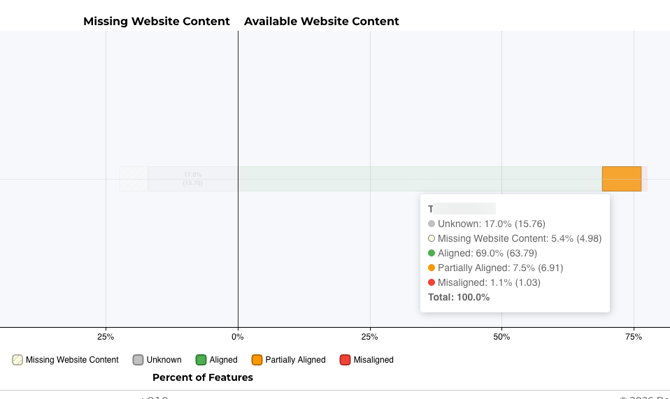
In this Example, this travel brand has 69% Aligned Content.
Partially Aligned
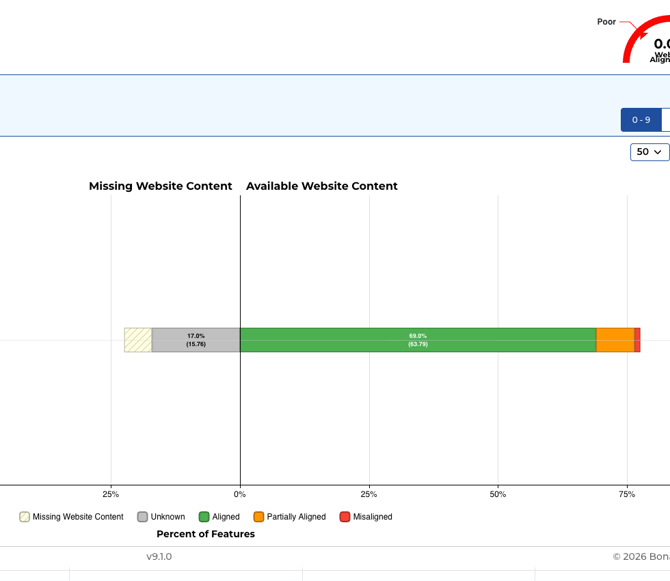
A prompt is marked Partially Aligned when your website has the relevant information, but the LLM's response doesn't fully match it. The model is trying to construct an answer and getting part of the way there, but something is off — it may be incomplete, imprecise, or inconsistent across different models. Partially Aligned content represents an opportunity: the raw material exists on your website, but it isn't being communicated to AI accurately enough to count as a clean win.
In this example, only 7.5% of their website is Partially Aligned
Missing Website Context
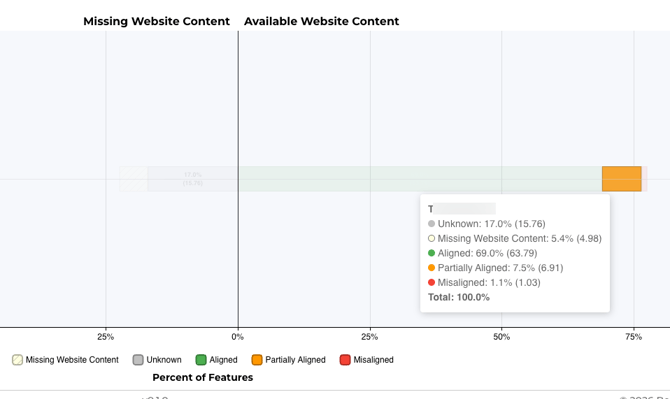
A prompt is marked Missing Website Content when the question being asked has no answer on your website at all. We've searched and cannot find it. Interestingly, LLMs may still attempt to answer these questions — which means travelers could be getting AI-generated responses about your brand that have no grounding in anything you've published. This category represents a true content gap: questions your customers are asking that your website currently can't answer.
In this example, 7.5% of the questions have no answers or corresponding content could not be found in the website.
Unknown
A prompt is marked Unknown when the answer is missing from both sides — your website doesn't have it, and the large language models don't have a clear answer either. This is the most opaque category: there's no website content to align to, and no LLM response to compare it against. Unknown prompts are often edge cases or niche questions where neither your content team nor the AI models have addressed the topic yet.
In this example, 17% of the prompts are missing in both LLMs (LLMs are unclear in their answers) nor the answers could be found on your website.
The key thing to remember when presenting these: Website Alignment is exclusively based on what's found on the website. It is not the same as LLM accuracy (which compares LLM responses against your official verified answers). Website Alignment asks a more fundamental question — does your website even have the content, and are LLMs picking it up correctly?