
In the boardroom, we are conditioned to love graphs that go up and to the right. We want revenue up, engagement up, and customer satisfaction up. But when it comes to preparing your brand for the age of Artificial Intelligence, you need to prepare yourself for a counter-intuitive reality: To make your brand truly visible to the machine, your accuracy score is going to crash before it recovers.
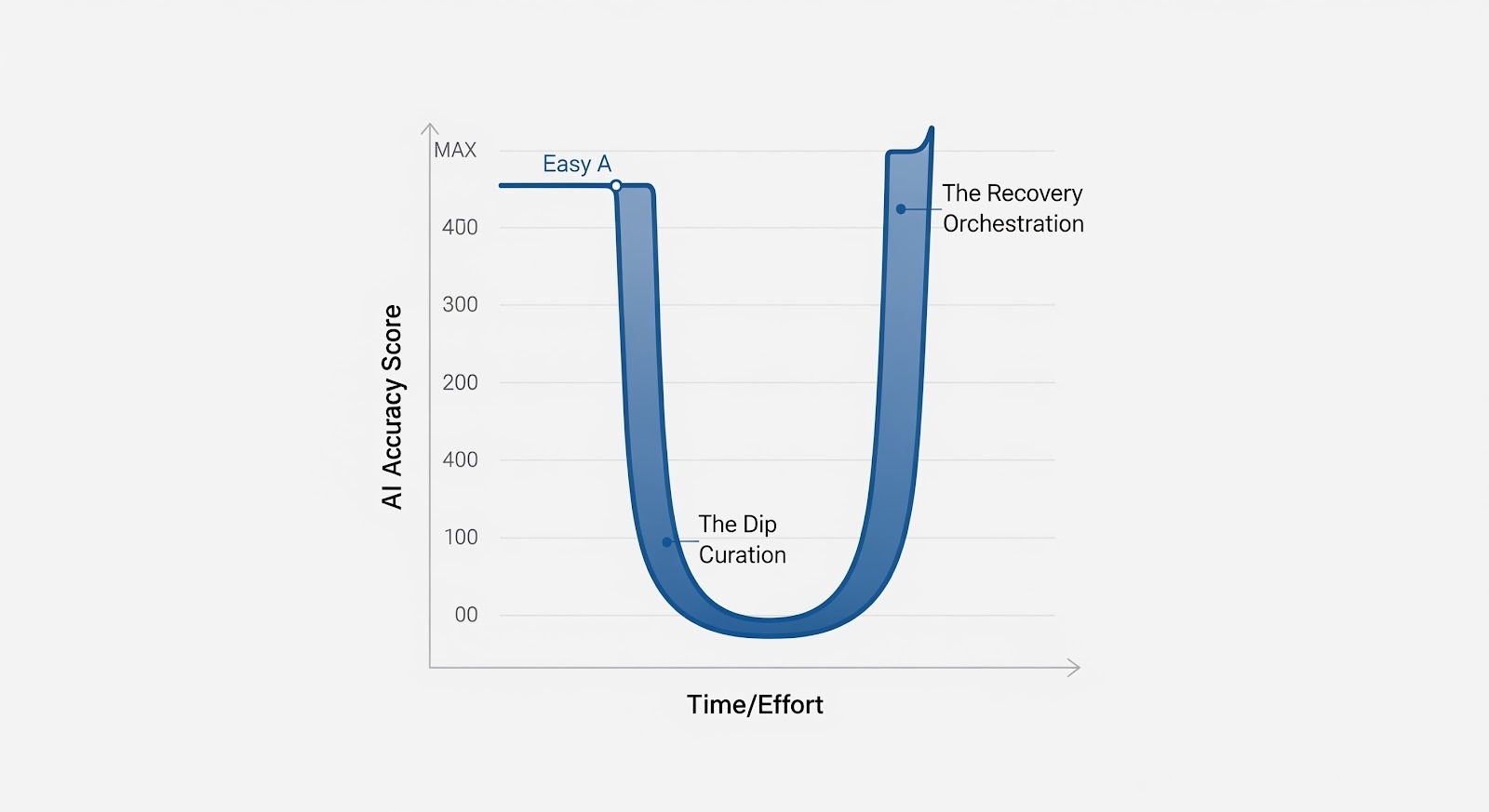
We call this the "U-Shape" phenomenon, and it is the only way to bridge the gap between a marketing website designed for humans and the data-hungry "Prediction Engines" that will drive the future of commerce.
The Trap of the "Easy A"
When we first scan a brand’s digital presence to see how well AI models (like ChatGPT or Gemini) understand it, the initial results often look surprisingly good. You might see a high accuracy score and think, "Great, the AI knows who we are."
This is a dangerous illusion.
The AI is getting an "Easy A" because it is currently only being tested on the basics. It knows your address. It knows you have a pool. It knows your check-in time. It knows these things because they are explicitly stated on your public website. The denominator of the test—the total number of questions we are grading—is small and consists only of "low-hanging fruit".
But your customers don't just ask the basics. They ask the hard questions: "Is the pool heated to 82 degrees?", "Do you have gluten-free bagels at the breakfast bar?", "Can I charge a Tesla Model Y specifically?"
This information isn't usually on your website. It is "Tribal Knowledge"—facts locked inside the heads of your concierges, your general managers, and your product teams. To the AI, this data doesn't exist.
The Courage to Crash (The Dip)
This is where the work of Curation begins, and where the "U-Shape" dip occurs.
To make your brand AI-ready, you must begin digitizing that tribal knowledge. You start inputting hundreds of new facts into the system—creating a new, expanded "System of Record" or “Official Responses”.
Here is the math behind the crash:
- Your team curates and provides in-depth, contextual responses to this set of 300 questions. In other words, you introduce 300 new, difficult questions into the test.
- The AI has not been taught the answers to these questions yet.
- The new curated answers are compared against the LLMs previous answers likely AI guesses, "I don't know" or (“-”- answer) therefore scoring them as “inaccurate”
- Consequently, your Accuracy Score drops precipitously.
This dip causes panic for the uninitiated. It looks, on the surface, as though your knowledge base and corresponding accuracy with LLMs is getting worse. In reality, you are finally exposing the "Invisible Gap"—the vast amount of information your customers need that the AI simply didn't know it was missing.
As our internal data analysis shows, this dip is inevitable. You are effectively moving the goalposts from a middle-school quiz to a PhD dissertation. The AI fails the dissertation initially because it hasn't studied the new material.
The Recovery: Orchestration
The upward swing of the "U"—the recovery—happens through Content Orchestration.
Once you have curated those hundreds of new answers, we don't just leave them in a database. We translate them into Question and Answer (Q&A) pairs, the native language of Large Language Models. We create a machine-readable knowledge base that is invisible to humans but "tasty" for AI crawlers.
When the AI crawlers return, they don't just see the "Easy A" content anymore. They digest the deep tribal knowledge you have exposed.
- They learn the pool temperature.
- They learn the specific EV charger types.
- They learn the dietary restrictions you cater to.
Suddenly, the AI starts getting the hard questions right. Your score corrects and trends upward completing the "U-Shape".
The Future is Agentic
Why go through this pain? Because we are rapidly approaching the era of Agentic Commerce—a world where personal AI agents will book travel and buy products autonomously.
In that world, a 10% error rate is a commercial catastrophe. If an AI books a family at a hotel that it thinks has a heated pool, but actually doesn't, that customer is lost forever.
The brands that will win in this new era are the ones brave enough to endure the dip. They are the ones who realize that a high score based on shallow data is worthless, and that true authority comes from teaching the machine the secrets that only you know.
Analogy for Understanding: Imagine a student taking a history test.
- Phase 1: The teacher asks 10 questions from Chapter 1 (your website). The student gets 9/10 right. Score: 90%. (This is the "Easy A").
- Phase 2 (Curation): The teacher suddenly adds 10 new questions from Chapter 10 (your tribal knowledge). The student hasn't read that chapter yet, so they guess and get them all wrong. Now the student has 9 correct answers out of 20 total questions. Score drops to 45%. (This is the Dip).
- Phase 3 (Orchestration): The teacher gives the student the textbook for Chapter 10. They retake the test and get the new questions right. Score rises to 95%. (This is the Recovery).